Smart bulbs in 2026 deliver brighter whites, truer colors, and smoother smart-home integration than ever.
This guide compares brightness, color fidelity, hub needs, and Matter support so you can pick bulbs that work with your setup.
Budget-friendly picks and pro-level options are highlighted for clear buying choices.
Read on for straightforward recommendations that save time and avoid common pitfalls.
| DAYBETTER Wi‑Fi RGBW Smart Light Bulbs A19 (6-Pack) |

| Best Multi-Pack Value | Connectivity: 2.4 GHz Wi‑Fi (Tuya) | Voice Control: Alexa, Google Assistant | Color/White Options: RGBW (multicolor + cool/warm white) | VIEW LATEST PRICE | Read Our Analysis |
| Linkind Matter Smart RGB TW A21 LED Bulbs (4-Pack) |

| Best Matter Integration | Connectivity: Matter (2.4 GHz Wi‑Fi; Bluetooth possible) | Voice Control: Alexa, Google, Apple Home (via Matter/controller) | Color/White Options: RGBTW (multicolor + tunable white 1800K–6500K) | VIEW LATEST PRICE | Read Our Analysis |
| Linkind Smart A19 LED Bulbs (2700K-6500K 4-Pack) |

| Best Tunable White | Connectivity: 2.4 GHz Wi‑Fi and Bluetooth | Voice Control: Alexa, Google Assistant | Color/White Options: Tunable white 2700K–6500K (no full RGB) | VIEW LATEST PRICE | Read Our Analysis |
| Kasa Multicolor A19 Smart Wi-Fi Bulb (KL125) |

| Best App Ecosystem | Connectivity: 2.4 GHz Wi‑Fi | Voice Control: Alexa, Google Assistant | Color/White Options: Full color (16M) + Auto White 2500K–6500K | VIEW LATEST PRICE | Read Our Analysis |
| Amazon Basics Smart A19 Color-Changing LED Bulb (9W) |

| Best Alexa Native | Connectivity: 2.4 GHz Wi‑Fi | Voice Control: Alexa only | Color/White Options: Color-changing (16 preset colors) + white | VIEW LATEST PRICE | Read Our Analysis |
| Meross Smart WiFi Multicolor LED Bulbs (2-Pack) |
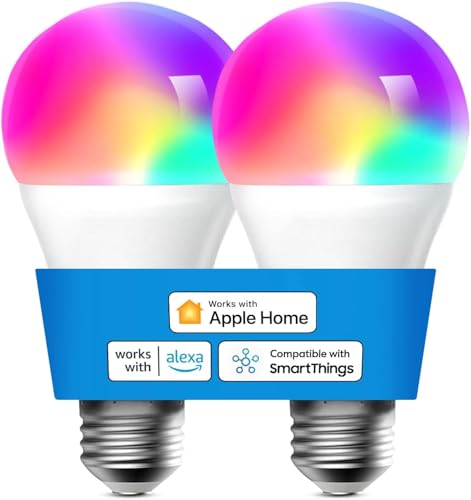
| Best HomeKit Friendly | Connectivity: 2.4 GHz Wi‑Fi (Meross app) | Voice Control: Siri/HomeKit, Alexa, SmartThings | Color/White Options: RGBWW (16M colors + 2700K–6500K) | VIEW LATEST PRICE | Read Our Analysis |
| WiZ Smart A19 Full-Color LED Bulb (E26 Matter) |

| Best Smart Automation | Connectivity: 2.4 GHz Wi‑Fi and Bluetooth (Matter compatible) | Voice Control: Alexa, Google, Siri/Apple Home (via Matter) | Color/White Options: Full color (16M) + warm-to-cool whites | VIEW LATEST PRICE | Read Our Analysis |
More Details on Our Top Picks
DAYBETTER Wi‑Fi RGBW Smart Light Bulbs A19 (6-Pack)
If you want an affordable, no‑hub starter pack that’s easy to set up and control from anywhere, the DAYBETTER 6‑pack is a strong choice—its Tuya Wi‑Fi connectivity (2.4 GHz) and app grouping let you manage multiple rooms remotely while Alexa and Google voice support handle hands‑free control. You’ll use the Tuya Smart app to change RGBCW colors, adjust cool/warm white, and dim from 1%–100%. Schedule timers and automations for arrival or sleep routines. Each 9W LED delivers about 800 lumens in an A19 E26/E27 form factor, so you screw them in and start saving—no hub required.
- Connectivity:2.4 GHz Wi‑Fi (Tuya)
- Voice Control:Alexa, Google Assistant
- Color/White Options:RGBW (multicolor + cool/warm white)
- Dimmable Range:1%–100% dimming
- Base/Form Factor:A19, E26/E27 base
- No Hub Required:No hub required (direct Wi‑Fi/Tuya)
- Additional Feature:Tuya Smart app support
- Additional Feature:Grouping for multiple bulbs
- Additional Feature:Arrival/departure scheduling
Linkind Matter Smart RGB TW A21 LED Bulbs (4-Pack)
You’ll appreciate the Linkind Matter Smart RGB TW A21 4-pack if you want bright, color‑changing bulbs that play nicely with Matter ecosystems and deliver 1600 lumens at just 14W. You’ll get A21 bulbs with E26 bases, 16 million colors plus tunable white (1800K–6500K), CRI 90, and a rated 25,000‑hour life. They bridge with Matter controllers (Apple Home, Alexa, Google Home, SmartThings) over 2.4 GHz Wi‑Fi, offer app and voice control, grouping, schedules, and microphone music sync via AiDot. Smooth 1%–100% dimming works, but don’t use traditional wall dimmers to avoid flicker.
- Connectivity:Matter (2.4 GHz Wi‑Fi; Bluetooth possible)
- Voice Control:Alexa, Google, Apple Home (via Matter/controller)
- Color/White Options:RGBTW (multicolor + tunable white 1800K–6500K)
- Dimmable Range:1%–100% dimming
- Base/Form Factor:A21, E26 base
- No Hub Required:No separate hub required (Matter over Wi‑Fi/controller)
- Additional Feature:Matter-certified compatibility
- Additional Feature:1600 lumens brightness
- Additional Feature:Microphone music sync
Linkind Smart A19 LED Bulbs (2700K-6500K 4-Pack)
For renters and families who want easy, reliable tunable white lighting without rewiring, the Linkind Smart A19 bulbs deliver 2700K–6500K color temperature control, strong color fidelity (CRI>90), and 800 lumens per bulb. You’ll get 60W-equivalent output using just 8.5W, lasting about 25,000 hours and saving up to 85% energy versus incandescent. Control’s flexible: AiDot app, Alexa, Google Assistant, or local Bluetooth after setup; Wi‑Fi (2.4 GHz) enables remote access. Smooth 1%–100% dimming via app/voice (don’t use traditional dimmer switches). Pack of four suits 10–20 m² rooms. Warranty and return info available from the seller.
- Connectivity:2.4 GHz Wi‑Fi and Bluetooth
- Voice Control:Alexa, Google Assistant
- Color/White Options:Tunable white 2700K–6500K (no full RGB)
- Dimmable Range:1%–100% dimming
- Base/Form Factor:A19, E26 base
- No Hub Required:No hub required (Wi‑Fi/Bluetooth)
- Additional Feature:Bluetooth local control
- Additional Feature:Sunrise simulation scheduling
- Additional Feature:CRI > 90
Kasa Multicolor A19 Smart Wi-Fi Bulb (KL125)
Ideal for anyone who wants multicolor lighting without a hub, the Kasa KL125 delivers bright 800-lumen output, 16 million colors and automatic dawn-to-dusk white tuning in a single A19, 9W package. You’ll get dimmable color plus Auto White (2500K–6500K) that shifts with natural light, making it great for holiday accents, focused study, or cozy dinners. It connects directly over 2.4 GHz Wi‑Fi—no hub—supports Alexa and Google voice control, and the Kasa app lets you change colors, schedule timers, and monitor energy in real time. UL certified, backed by Kasa’s 2‑year warranty.
- Connectivity:2.4 GHz Wi‑Fi
- Voice Control:Alexa, Google Assistant
- Color/White Options:Full color (16M) + Auto White 2500K–6500K
- Dimmable Range:Dimmable (no exact % listed; app/voice control)
- Base/Form Factor:A19, E26 base
- No Hub Required:No hub required (Kasa Wi‑Fi)
- Additional Feature:Automatic color-temperature adjustment
- Additional Feature:Real-time energy monitoring
- Additional Feature:2-year warranty
Amazon Basics Smart A19 Color-Changing LED Bulb (9W)
If you rely on Alexa as your smart-home hub, the Amazon Basics Smart A19 Color‑Changing LED is a straightforward, budget-friendly pick that gives you full voice and app control without a separate hub. You’ll connect it to 2.4 GHz Wi‑Fi via the Alexa app, link it to your Amazon account for optional zero‑touch setup, and see “First light bulb found” during pairing. Voice and remote app control let you dim (5%–100%), change among 16 preset colors, group bulbs by room, and build routines for schedules or away‑mode. At 9W (800 lm) it replaces a 60W incandescent and suits interior or damp locations.
- Connectivity:2.4 GHz Wi‑Fi
- Voice Control:Alexa only
- Color/White Options:Color-changing (16 preset colors) + white
- Dimmable Range:5%–100% dimming
- Base/Form Factor:A19, E26 base
- No Hub Required:No hub required (Alexa/Wi‑Fi)
- Additional Feature:Alexa zero‑touch setup
- Additional Feature:Works exclusively with Alexa
- Additional Feature:Damp-location rated
Meross Smart WiFi Multicolor LED Bulbs (2-Pack)
You’ll appreciate the Meross Smart WiFi Multicolor bulbs if you want a simple, hub-free way to add full-color lighting and tunable white to any room—just screw them in, connect to 2.4 GHz Wi‑Fi, and control 16 million colors plus 2700–6500K whites with Siri, Alexa, or the Meross app. You’ll get 900 lumens (60W equivalent) from each 9W bulb, dimming and preset scenes for movie, work, or party. They work with HomeKit, SmartThings, Android, and voice assistants, support secure AWS-encrypted storage, and use an advanced IoT chip to reduce dropouts. Set schedules, remote-control lights, and save energy versus incandescent bulbs.
- Connectivity:2.4 GHz Wi‑Fi (Meross app)
- Voice Control:Siri/HomeKit, Alexa, SmartThings
- Color/White Options:RGBWW (16M colors + 2700K–6500K)
- Dimmable Range:Dimmable (app/voice; percentage not specified)
- Base/Form Factor:A19, E26 base
- No Hub Required:No hub required (Meross Wi‑Fi/HomeKit)
- Additional Feature:Apple HomeKit support
- Additional Feature:AWS-encrypted data storage
- Additional Feature:Advanced IoT chip
WiZ Smart A19 Full-Color LED Bulb (E26 Matter)
Pick the WiZ Smart A19 if you want a plug-and-play, Matter-compatible bulb that gives rich multicolor light and works without a hub—just screw it into any E26 fixture, connect to 2.4 GHz Wi‑Fi, and control it via WiZ, Bluetooth, voice assistants, or HomeKit. You’ll get an 8.8W LED (60W equivalent) with 800 lumens, 16 million colors, and warm-to-cool whites that dim smoothly. Use the WiZ app, presets, schedules, or voice with Alexa, Google, or Siri; link with SmartThings or IFTTT. SpaceSense motion features and sunset-to-sunrise automation add convenience. It includes a two‑year warranty and ships as a single bulb.
- Connectivity:2.4 GHz Wi‑Fi and Bluetooth (Matter compatible)
- Voice Control:Alexa, Google, Siri/Apple Home (via Matter)
- Color/White Options:Full color (16M) + warm-to-cool whites
- Dimmable Range:Dimmable (app/voice; percentage not specified)
- Base/Form Factor:A19, E26 base
- No Hub Required:No hub required (Wi‑Fi/Bluetooth/Matter)
- Additional Feature:SpaceSense motion lighting
- Additional Feature:Matter certification
- Additional Feature:IFTTT integration
Factors to Consider When Choosing a Smart Bulb
Before you pick a bulb, I’ll walk you through the key factors that actually matter: connectivity and protocols, voice assistant compatibility, and how bright the bulb gets in lumens. I’ll also cover color and white-range options plus the app features and automation you’ll use day to day. That way you can choose a bulb that fits your setup and routines.
Connectivity And Protocols
When I choose a smart bulb, the way it connects is one of the first things I check because compatibility and control options determine how smoothly it will work in my home. I always confirm the wireless band—many bulbs need 2.4 GHz and won’t join a 5 GHz‑only network. I check supported protocols (Matter, Zigbee, Z‑Wave, Bluetooth, Wi‑Fi) since that dictates which hubs and ecosystems can manage the bulb. For reliable multi‑room setups I prefer bulbs that work natively with my controller rather than via third‑party bridges. I weigh local control (Bluetooth or LAN) against cloud‑only systems because local control cuts latency and keeps lights functional during outages. Finally, I consider mesh behavior and Wi‑Fi range for coverage in larger homes.
Voice Assistant Support
Connectivity affects how you’ll speak to your lights, so I check voice assistant support next to make sure my chosen bulb actually responds the way I want. First I confirm which assistants I use—Alexa, Google Assistant, Siri/HomeKit—and rule out bulbs that don’t support them. I prefer bulbs that work natively over Wi‑Fi or Matter instead of forcing a proprietary hub; hubless devices simplify setup and voice control. I also verify voice commands cover full functionality—on/off, brightness, color temperature, color changes, and scenes—not just basic toggles. When privacy and reliability matter, I favor options that offer local network control or local voice processing over cloud‑only integrations. Choosing Matter‑compatible bulbs helps future‑proof cross‑ecosystem interoperability.
Brightness And Lumens
Because brightness determines whether a bulb actually lights a space the way you need it, I start by checking lumens—the real measure of light output—rather than watts. I pick roughly 800 lm to replace a 60W incandescent for general lighting and about 1600 lm for a 100W equivalent when a room or task area needs more punch. For reading or kitchen prep I aim 700–1500 lm; for ambient or accent zones 200–600 lm usually suffices. I compare lumens per watt to judge efficiency—higher lm/W lowers operating cost. I also add lumen totals from all fixtures when planning layered lighting to meet recommended lux (300–500 lux for kitchens, 100–300 for living areas). Finally, I note colored modes often yield lower white-mode output.
Color And White Range
If you want a smart bulb that’s useful as well as fun, I start by checking whether it offers RGB, tunable white, or both—RGB gives you color effects, tunable white handles real-world lighting, and RGBW/RGBWW models do both. I check the Kelvin range next: roughly 1800K–6500K covers ultra-warm to daylight; 1800–3000K feels cozy, 5000–6500K suits task lighting. CRI matters for accuracy—aim for 90+ if you care about makeup, cooking, or photography. I also verify dimming: true 1%–100% dimming with smooth shifts beats bulbs that jump. Finally, if you want lighting that follows your day, I prefer bulbs supporting automated color-temperature schedules for dawn-to-dusk and sleep-wake shifts.
App Features And Automation
When I pick a smart bulb, the app and its automation capabilities are as important as the hardware—good software turns bulbs into a truly smart lighting system. I prioritize apps with reliable scheduling, timers, and sunrise/sunset routines so lights follow my day without manual input. Grouping and scene presets let me control rooms and recall favorite color/brightness combos instantly. I want both remote cloud control and local/offline options so I can manage lights from anywhere but still operate when the internet fails. Advanced automations and integrations (IFTTT, shortcuts, home hub rules) let sensors, voice assistants, or other devices trigger lighting intelligently. Extras like music-sync, firmware updates, energy monitoring, and user access controls boost functionality and long-term reliability.
Power Use And Efficiency
Since I want a bulb that saves money and energy, I always check its lumens per watt and actual wattage so I can compare efficiency across models. I pick LEDs that list both lm/W and watts so I can see which delivers the most light per energy consumed. I compare actual wattage to the incandescent equivalent—like a 9W LED vs a 60W incandescent—to estimate savings. I also consider dimmability range (1%–100%) because smooth low‑level dimming cuts average power use and prolongs life. Rated operating life and expected efficiency degradation matter too; longer life means fewer replacements and lower lifetime energy and material costs. Finally, I account for standby and connectivity draw—Wi‑Fi or mesh features add constant watts that affect total energy.
Compatibility With Fixtures
Although I focus on smart features, I always start by checking physical fit and fixture compatibility so the bulb actually works where I want it. I measure shape and base type—A19 with E26/E27 or larger A21 profiles—and confirm socket depth to avoid clearance issues. I compare bulb dimensions and lumen output to the fixture’s enclosure: enclosed or recessed housings can trap heat and reduce light, so I pick bulbs rated for those environments. I verify fixture support for dimming or color tuning and avoid pairing smart bulbs with legacy wall dimmers that cause flicker or damage. For multi‑bulb fixtures I match type, color range, and CRI for uniform scenes, and I check wattage/heat specs to make certain safe operation.
Warranty And Support
Because smart bulbs blend hardware and software, I always treat warranty and support as core parts of my buying decision. I check warranty length and coverage—most bulbs offer 1–2 years—and confirm whether LED failure, driver/electronics faults, or connectivity problems are included, and whether accidental damage is excluded. I also note return and refund policies, like 30‑day windows, and who handles returns: retailer or manufacturer. Ongoing firmware updates and app support matter because software issues crop up after purchase, so I verify support channels (email, phone, chat). Finally, I ask about claim procedures: proof of purchase, serial numbers, and whether replacements are new, refurbished, or repaired, so I’m not surprised later.
Frequently Asked Questions
How Do Smart Bulbs Affect Home Wi‑Fi Bandwidth and Network Performance?
Smart bulbs consume very little data, so they seldom reduce Wi‑Fi speed. Many models connect via Zigbee or Bluetooth which keeps traffic off the Wi‑Fi network. However, if dozens of bulbs are connected directly over Wi‑Fi they can increase Wi‑Fi channel congestion and place extra load on a router during firmware updates.
Can Smart Bulbs Be Used With Dimmer Switches Safely?
Yes, but I do not recommend connecting most smart bulbs to traditional dimmer switches. Use a dimmer designed for smart bulbs or keep the wall switch turned on, because mismatched controls can cause flickering, shorten bulb life, or damage the bulb electronics.
What Privacy Risks Come From Smart Bulb Companion Apps?
Smart bulb companion apps may expose precise personal information such as account identifiers, home address metadata, and detailed lighting schedules when they synchronize settings to cloud services or communicate with remote servers. Insecure or improperly authenticated APIs can reveal device IP addresses, unique hardware IDs, and real time usage events that indicate when occupants are home or away. Some apps request or access more permissions than required for lighting control and then transmit analytics or advertising identifiers to marketing partners. Unpatched vulnerabilities and weak authentication mechanisms can allow attackers to hijack user accounts or take control of connected bulbs and scenes, enabling surveillance or unauthorized access to other devices on the same network.
How Long Do Firmware Updates Typically Continue for a Bulb Model?
Surprisingly short. Firmware updates for a bulb model typically continue for about two to five years. Premium brands sometimes support updates longer, while budget lines often stop after one to three years, so plan accordingly.
Are There Recycling or Disposal Programs for Smart Bulbs?
Yes. I return them via manufacturer take-back programs, retailer trade-in events, or municipal hazardous waste collections. I also verify local e-waste regulations and specific brand recycling partnerships before disposal.
Final Thoughts
Choosing the right smart bulb comes down to what you actually need: brightness, color accuracy, connectivity, and whether you want local control or Matter compatibility. For example, I swapped my living-room bulbs to Linkind A21s for movie nights and tuned the CRI>90 whites for recipe prep—brighter, truer colors and instant response from local controls made cooking and streaming noticeably better. Pick bulbs that solve your everyday hassles, not just the flashiest specs.