Thermostats with room sensors deliver steadier temperatures across different rooms, cut energy waste, and keep controls simple.
Top 2026 models like ecobee Smart Thermostat Premium, Honeywell Home T9, GE Cync, ecobee4, Provirtec TH-01, and Lennox S40 balance hot and cold spots and learn routines.
These systems fit a wider range of homes and offer useful remote and scheduling features.
For anyone who’s argued about a stubborn bedroom, these picks make temperature fights a lot less common.
| Honeywell Home T9 WiFi Smart Thermostat with Sensor |

| Best Overall | Sensor Support: 1 included sensor | Wi‑Fi Connectivity: Wi‑Fi | App Control: Resideo app | VIEW LATEST PRICE | Read Our Analysis |
| ecobee Smart Thermostat Premium with Air Quality Monitor |

| Premium Pick | Sensor Support: 1 included SmartSensor | Wi‑Fi Connectivity: Wi‑Fi and Bluetooth | App Control: ecobee app | VIEW LATEST PRICE | Read Our Analysis |
| Honeywell Home T9 WiFi Smart Thermostat |
| Best for Smart Homes | Sensor Support: Sensor ready | Wi‑Fi Connectivity: Wi‑Fi | App Control: Honeywell Home app | VIEW LATEST PRICE | Read Our Analysis |
| GE Cync Smart Temperature Sensor for Smart Thermostat |

| Best Sensor | Sensor Support: 1 included sensor | Wi‑Fi Connectivity: Wi‑Fi and Bluetooth | App Control: Cync app | VIEW LATEST PRICE | Read Our Analysis |
| Smart Thermostat with Room Sensor and WiFi Control |

| Best Budget Pick | Sensor Support: 1 included room sensor | Wi‑Fi Connectivity: 2.4 GHz Wi‑Fi | App Control: Prodigytec app | VIEW LATEST PRICE | Read Our Analysis |
| ecobee4 Smart Thermostat with Built-in Alexa Room Sensor Included |

| Best with Alexa | Sensor Support: 1 included room sensor | Wi‑Fi Connectivity: Wi‑Fi | App Control: ecobee app | VIEW LATEST PRICE | Read Our Analysis |
| Lennox Smart Room Sensor for S40 Thermostat |

| Best for Lennox Systems | Sensor Support: Compatible sensor | Wi‑Fi Connectivity: BLE mesh | App Control: Thermostat-controlled | VIEW LATEST PRICE | Read Our Analysis |
More Details on Our Top Picks
Honeywell Home T9 WiFi Smart Thermostat with Sensor
If you want a thermostat that can actually tell the difference between the hall and the bedroom, the Honeywell Home T9 WiFi Smart Thermostat with Sensor is a strong fit. You get a touchscreen, app control, and voice help through Alexa, Google Assistant, and HomeKit. It works with Smart Room Sensors so you can track temperature and humidity where you live most. Because it can average multiple rooms, your comfort feels more even. It also supports Auto Home/Away scheduling, ENERGY STAR savings, and DIY wall-mount setup. Check C-wire needs first.
- Sensor Support:1 included sensor
- Wi‑Fi Connectivity:Wi‑Fi
- App Control:Resideo app
- Voice Assistants:Alexa, Google, HomeKit
- HVAC Compatibility:Multi-system HVAC
- Wall Mount:Wall mount
- Additional Feature:Touchscreen display
- Additional Feature:Auto Home/Away scheduling
- Additional Feature:200 ft sensor range
ecobee Smart Thermostat Premium with Air Quality Monitor
The ecobee Smart Thermostat Premium with Air Quality Monitor is a smart pick for homes that want comfort, energy savings, and a little extra peace of mind in one device. You get a vivid display, built-in smart speaker, and one included SmartSensor to help balance rooms. It can save up to 26% on heating and cooling costs. Then, its air quality alerts, smoke detection, and open-window pause features help you protect your home. It works with Siri, Alexa, Google Assistant, and HomeKit. Plus, setup stays simple, even without a C-wire.
- Sensor Support:1 included SmartSensor
- Wi‑Fi Connectivity:Wi‑Fi and Bluetooth
- App Control:ecobee app
- Voice Assistants:Siri, Alexa, Google
- HVAC Compatibility:24VAC systems
- Wall Mount:Wall mount
- Additional Feature:Built-in air quality monitor
- Additional Feature:Occupancy radar sensing
- Additional Feature:Pause HVAC on open doors
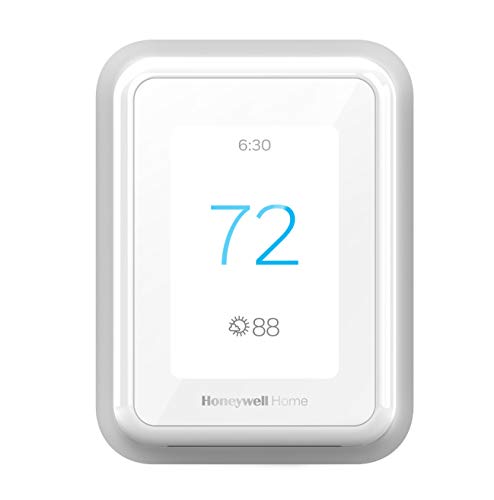
Honeywell Home T9 WiFi Smart Thermostat
Honeywell Home T9 Wi-Fi Smart Thermostat is a strong pick for households that want room-by-room comfort without constant fuss. You get a clean touchscreen, voice control with Alexa or Google Assistant, and Smart Room Sensor support when you add sensors later. It learns your heating and cooling habits, switches between heat and cool on its own, and uses geofencing for Home and Away comfort. You can check energy reports, get filter alerts, and use the included power adapter if your home lacks a C-wire. It fits many systems, though not electric baseboard heat.
- Sensor Support:Sensor ready
- Wi‑Fi Connectivity:Wi‑Fi
- App Control:Honeywell Home app
- Voice Assistants:Alexa, Google
- HVAC Compatibility:Forced air/heat pump
- Wall Mount:Wall mount
- Additional Feature:Smart Response learning
- Additional Feature:Monthly energy report
- Additional Feature:Geofencing auto mode
GE Cync Smart Temperature Sensor for Smart Thermostat
Room comfort gets a lot easier to manage when your thermostat can “hear” the whole house, and that’s where the GE Cync Smart Temperature Sensor stands out. You pair it with the GE Cync Smart Thermostat, then let it track temperature and humidity in real time. That helps you cut hot and cold spots and keeps each room steadier through the day. The tiny 1.6-inch white sensor mounts easily with a screw or tape, uses a battery, and works with the Cync app, Alexa, and Google Home for simple control.
- Sensor Support:1 included sensor
- Wi‑Fi Connectivity:Wi‑Fi and Bluetooth
- App Control:Cync app
- Voice Assistants:Alexa, Google
- HVAC Compatibility:Cync thermostat only
- Wall Mount:Wall mount
- Additional Feature:Measures temperature and humidity
- Additional Feature:No bridge required
- Additional Feature:Battery-powered sensor
Smart Thermostat with Room Sensor and WiFi Control
Provirtec’s Smart Thermostat TH-01 is a smart pick if you want room-by-room comfort without constant guesswork, because it pairs Wi-Fi control with a thermo-hygrometer sensor that checks both temperature and humidity where you actually live and sleep. You can use the Prodigytec app or the touchscreen, so you stay in control from the couch or down the hall. It works with most 24 VAC systems, including heat pumps, boilers, and furnaces. Seven-day schedules, Sleep, Home, and Away modes help you save energy. If Wi-Fi drops, it keeps running locally, which is a quiet relief.
- Sensor Support:1 included room sensor
- Wi‑Fi Connectivity:2.4 GHz Wi‑Fi
- App Control:Prodigytec app
- Voice Assistants:SmartThings compatible
- HVAC Compatibility:24VAC HVAC systems
- Wall Mount:Wall mount
- Additional Feature:7-day scheduling
- Additional Feature:Local control fallback
- Additional Feature:Body-temperature sleep mode
ecobee4 Smart Thermostat with Built-in Alexa Room Sensor Included
The ecobee4 Smart Thermostat with Built-in Alexa and Room Sensor Included is a smart pick if you want tighter comfort control without constant fuss. You get voice help, app control, and a clear backlit display in one sleek white wall unit. Because it’s Wi-Fi connected, you can adjust heating, cooling, and compatible heat pump or humidifier settings from anywhere. The included room sensor helps balance uneven spaces, so one chilly room doesn’t ruin your day. It also works with Alexa, Google Assistant, HomeKit, SmartThings, iOS, Android, and IFTTT, which makes setup feel easy.
- Sensor Support:1 included room sensor
- Wi‑Fi Connectivity:Wi‑Fi
- App Control:ecobee app
- Voice Assistants:Alexa, HomeKit, Google
- HVAC Compatibility:Heat pump/humidifier
- Wall Mount:Wall mount
- Additional Feature:Built-in Alexa Voice Service
- Additional Feature:Room sensor included
- Additional Feature:Programmable thermostat
Lennox Smart Room Sensor for S40 Thermostat
If you’re tired of one part of the house feeling too hot while another feels too cold, the Lennox Smart Room Sensor for the S40 thermostat can be a smart fix. You can place this wireless sensor in the room that matters most, and it checks both temperature and occupancy. Then your S40 blends that data with its built-in sensors for steadier comfort. You can pair up to six sensors, and the LED tells you if the battery is low or the signal drops. It runs on included AA batteries and mounts cleanly on the wall.
- Sensor Support:Compatible sensor
- Wi‑Fi Connectivity:BLE mesh
- App Control:Thermostat-controlled
- Voice Assistants:Alexa, HomeKit, Google
- HVAC Compatibility:S40 thermostat only
- Wall Mount:Wall mount
- Additional Feature:Occupancy sensing
- Additional Feature:LED battery indicators
- Additional Feature:Pair up to six sensors
Factors to Consider When Choosing Thermostats With Room Sensors
When I help you choose a thermostat with room sensors, I first look at sensor placement range, HVAC compatibility, and whether your home needs a C-wire. I also check smart home support so the system works with your existing devices without extra hassle. Then I make sure the power source fits your setup, because the best thermostat should feel helpful, not fussy.
Sensor Placement Range
Because room sensors only help when they can talk to your thermostat or hub, I always start with placement range. I look for wireless models that promise about 50 to 200 feet in open air, then I remember that walls, floors, and metal can eat that distance fast. I place each sensor inside the maker’s stated limit so it keeps reporting on time instead of fading in and out. If a room sits behind concrete, brick, or ductwork, I move the sensor closer or aim for a clearer path. For homes with several sensors, I spread them across living spaces but stay in range. I also dodge Wi-Fi routers, microwaves, and cordless phones when I can, since they can add noise and trim signal strength.
HVAC Compatibility
A thermostat with room sensors only works well for you when it matches your HVAC system, so I always check that part first. I look for support for my exact setup, whether I use a single stage furnace, a heat pump with auxiliary heat, a boiler, a PTAC, or a fan coil unit. Next, I confirm the control voltage, since most smart models expect a 24 VAC circuit. I also check how many heating and cooling stages, plus fan speeds, the thermostat can handle, because a mismatch can make comfort feel uneven. Then I verify any needed accessories, like a relay or isolation module, are available. Finally, I want solid diagnostics and installer settings, so the sensors work cleanly with my equipment.
C-Wire Requirements
After I check HVAC compatibility, I look at the C-wire next, since many thermostats with room sensors need steady power to stay connected and responsive. I tell you to verify the wall wiring before you buy, because older heating setups often skip that extra conductor. If your system lacks one, I’d plan for a power extender kit, a powered adapter, or battery sensors, but I’d also know those choices can trim features and make polling less frequent. When I install a C-wire, I connect the furnace’s 24 VAC common terminal to the thermostat location, either with a spare wire or a new run. If you hire help, expect some labor cost, yet that small expense often beats flaky performance later.
Smart Home Support
Smart home support matters more than people think, and I always check it early so the thermostat fits the way you already live. I make sure it works with the voice assistants and platforms you already trust, like HomeKit or SmartThings, so you can speak a command and move on with your day. Next, I look at whether the system uses local control or leans on the cloud, because local support keeps basics alive when Wi-Fi gets flaky. I also check for native integrations, IFTTT, or open APIs if you want geofencing or room-based routines. Then I confirm that sensor data can drive custom automations. Finally, I want regular updates, clear sensor setup steps, and simple user permissions for family and guests.
Power Source Needs
Power matters more than most people expect, and I always check it right after smart home support because a thermostat can’t help you if it keeps losing power. I look for a C-wire first, since many smart thermostats need 24 VAC for steady operation. If the unit lacks one, I want a power extender or adapter so I’m not stuck with random outages. Then I check each room sensor’s power. Battery sensors are easy to place, but I plan for AA, AAA, or coin cell changes every year or two. I also watch wireless range, because walls, metal, and HVAC gear can shrink it fast. If the sensors sleep to save power, that’s a plus, and for whole-home setups, I count how many batteries I’ll need to replace.
App Control Features
I always start with the app, because it’s the part you’ll touch most often once the thermostat is on the wall. I want remote control that works when I’m away, so I can change temperature and mode over Wi-Fi or cellular without rushing home. I also look for multi-sensor tools, because I like to assign, group, or average room readings for steadier comfort. Next, I check for live temperature and humidity data, plus history and energy reports, since those clues help me spot a hot hallway or a chilly bedroom. Alerts matter too, especially for open doors, extreme temps, low battery, or HVAC trouble. Finally, I prefer voice assistant support and local fallback, because outages happen, and my comfort shouldn’t panic.
Temperature Scheduling
When you set up temperature scheduling, I’d look at how well the thermostat can follow real life, not just a neat calendar. I like room based schedules because bedrooms and living areas need different targets at different times. For empty hours, I’d set setbacks of 3 to 5°F, then let the system ramp up 30 to 60 minutes before people return. That way, comfort shows up on time, not late. I also prefer thermostats that can weight sensor readings, so the busiest room guides the schedule. Then I’d split weekdays from weekends and add night modes with tight bands of 1 to 2°F. Finally, I’d want holiday overrides and auto Away triggers, because an empty house shouldn’t heat or cool itself for no one.
Energy Efficiency Ratings
Energy efficiency ratings matter a lot once you start comparing thermostats with room sensors, because good comfort shouldn’t come with a surprise bill. I always look for ENERGY STAR or a similar label first, since it tells me the system meets real energy-saving standards. Then I check how the thermostat uses room data, because averaging or occupancy-based control can trim wasted runtime fast. I also value adaptive learning and smart scheduling, since they can shift setpoints before I even notice a change. Next, I make sure the sensors have solid range and long battery life, so weak signals don’t steal savings. Finally, I verify support for geofencing, auto-away, and demand-response. Those features help me cut waste when rooms sit empty.
Frequently Asked Questions
Can Room Sensors Work Through Thick Walls or Multiple Floors?
Room sensors can penetrate certain walls, but very thick walls and multiple floors usually reduce signal strength. Install sensors within the manufacturer’s recommended distance and keep them away from metal objects, large appliances, and other sources of radio interference for more reliable performance.
Do These Thermostats Require Professional Installation?
I can often install a thermostat myself because most models are straightforward. If your home has older or nonstandard wiring or if the new unit needs a common wire that your system lacks, hire a professional to prevent wiring errors and potential damage.
How Many Room Sensors Can One Thermostat Support?
That depends on the model. Most thermostats support between 1 and 6 room sensors, while some models can handle more. Check the specific model specifications because limits vary by brand and generation.
Will Room Sensors Affect Battery Life Significantly?
Room sensors typically do not cause significant battery drain; many units operate for 12 to 24 months on a single set. Expect only slight additional power use and standard battery replacement intervals rather than frequent changes.
Are Room Sensors Compatible With Existing HVAC Systems?
Yes. Most room sensors integrate with common HVAC setups, but compatibility depends on the thermostat model, the wiring configuration, and the type of heating or cooling equipment. Check the sensor and thermostat specifications, then contact the manufacturer or installer to confirm support before purchasing.
Final Thoughts
After testing a room sensor setup in my own home, I watched one chilly corner of the house stop feeling like a basement cave and start feeling normal. That small fix reminded me of a thermostat as a conductor, not a solo singer. The right system helps every room stay in tune, saves energy, and keeps daily life calmer. If you pick one with care, your home can feel balanced without constant tinkering or guesswork.