A well-chosen portable gas generator can power essential home circuits for far longer than a small inverter while still being safe for sensitive electronics. I tested models that balance runtime, outlets, and safety so you don’t have to guess which unit fits your needs.
Below are five reliable options with clear notes on capacity, fuel flexibility, and automatic transfer readiness. Read on for straightforward guidance to match a generator to your home.
| WEN 5600-Watt Portable RV-Ready Generator (GN5600) |
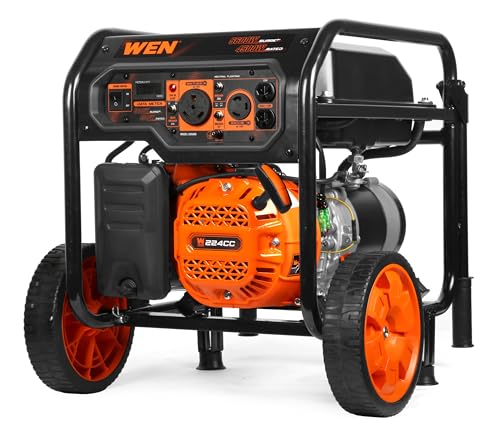
| Best for RVs | Running Watts (Rated Output): 4500 W | Starting/Peak Watts: 5600 W (starting) | Fuel Type / Fuel Options: Gasoline | VIEW LATEST PRICE | Read Our Analysis |
| ERAYAK 2400W Portable Quiet Inverter Generator |

| Quiet & Compact | Running Watts (Rated Output): 1800 W | Starting/Peak Watts: 2400 W (peak) | Fuel Type / Fuel Options: Gasoline | VIEW LATEST PRICE | Read Our Analysis |
| 11000W Tri-Fuel Inverter Generator for RV & Home |

| Whole-Home Power | Running Watts (Rated Output): 11,000 W | Starting/Peak Watts: 11,000 W (peak) | Fuel Type / Fuel Options: Gasoline / Propane / Natural Gas (tri-fuel) | VIEW LATEST PRICE | Read Our Analysis |
| Westinghouse 4650W Portable Gas Generator with CO Sensor |
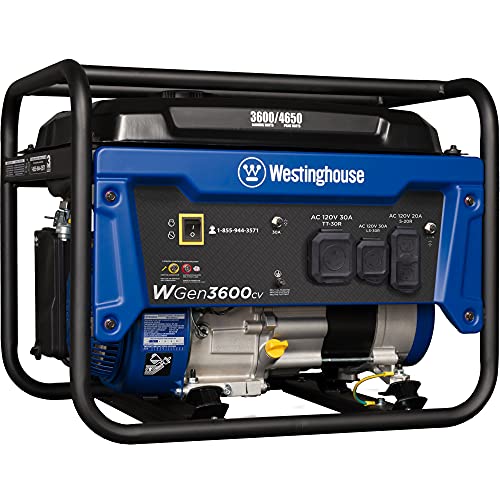
| Safety-Focused Pick | Running Watts (Rated Output): 3600 W | Starting/Peak Watts: 4650 W (peak) | Fuel Type / Fuel Options: Gasoline | VIEW LATEST PRICE | Read Our Analysis |
| PowerSmart 3800W Dual Fuel Inverter Generator |
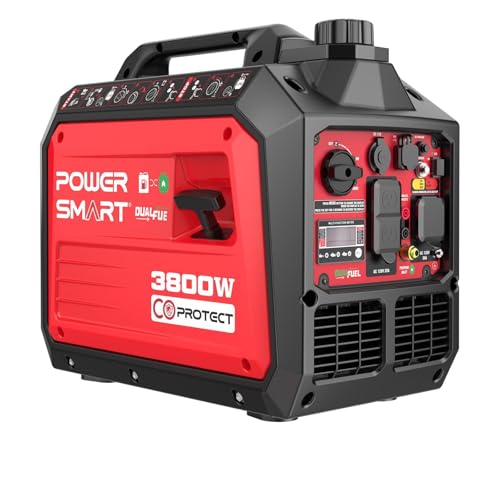
| Dual-Fuel Versatility | Running Watts (Rated Output): 3300 W (gasoline) / 3100 W (propane) | Starting/Peak Watts: 3800 W (gasoline) / 3500 W (propane) | Fuel Type / Fuel Options: Gasoline and Propane (dual fuel) | VIEW LATEST PRICE | Read Our Analysis |
More Details on Our Top Picks
WEN 5600-Watt Portable RV-Ready Generator (GN5600)
If you want a reliable backup that can run your RV and keep household essentials powered, the WEN 5600-Watt Portable RV-Ready Generator is a solid choice. You get 5600 starting watts and 4500 running watts, so you can boot large appliances and keep lights on. It uses a 224cc compliant engine and a 4.3-gallon tank, giving up to 12.5 hours at half load. You’ll appreciate the RV TT-30R outlet, a twist-lock L5-30R for transfer switches, and two 20-amp outlets for smaller devices. With wheels, a handle kit, and a three-year warranty, it’s easy to move and trust.
- Running Watts (Rated Output):4500 W
- Starting/Peak Watts:5600 W (starting)
- Fuel Type / Fuel Options:Gasoline
- Outlets / RV-Ready Connectivity:Two 120V 5-20R, one 120V 30A TT-30R (RV), one 120V 30A L5-30R
- Runtime (per tank or fuel spec):Up to 12.5 hours at half load (4.3 gal tank)
- Safety / CO or Low-Oil Protections:(Includes compliant engine; 3-year warranty) — standard safety features implied (low-oil shutdown not explicitly listed)
- Additional Feature:Wheel and handle kit
- Additional Feature:4.3-gallon fuel tank
- Additional Feature:Three-year limited warranty
ERAYAK 2400W Portable Quiet Inverter Generator
You’re going to like the ERAYAK 2400W Portable Quiet Inverter Generator when you need a lightweight, user-friendly backup that won’t steal the calm of your campsite or home. You’ll carry a 42 lb unit that fits tight spaces and plugs into two AC outlets, two USB ports, and a DC output. It runs cleaner with 0.2% to 1.2% THD, so your laptop and CPAP stay safe. Eco mode stretches fuel for up to 16 hours at light load and cuts noise to about 52.5 dB. You get a tool kit, oil funnel, manual, warranty, and support.
- Running Watts (Rated Output):1800 W
- Starting/Peak Watts:2400 W (peak)
- Fuel Type / Fuel Options:Gasoline
- Outlets / RV-Ready Connectivity:2 AC outlets, 2 USB ports, 1 DC output (total 4)
- Runtime (per tank or fuel spec):Up to 16 hours at 25% load (Eco mode); listed 8 hours (0.95 gal tank)
- Safety / CO or Low-Oil Protections:Electronic ignition, clean inverter output; EPA listed; manufacturer support (no explicit CO sensor listed)
- Additional Feature:Ultra-quiet 52.5 dB
- Additional Feature:Eco mode fuel-saving
- Additional Feature:0.2%–1.2% THD
11000W Tri-Fuel Inverter Generator for RV & Home
Choose the Gidrox 11000W Tri-Fuel Inverter Generator when you need serious, flexible power that keeps your home and RV running without drama. You’ll get 11,000 peak watts and pure sine wave output under 3% THD, so your laptop and medical gear stay safe. It runs on gas, propane, or natural gas, and an 8.7 gallon tank gives up to 21 hours of use. It’s RV ready with a 50A outlet and whole-home capable for a 5 ton AC. You’ll appreciate quiet, enclosed operation, ECO mode, CO shutdown, ATS readiness, remote start, and a three year warranty.
- Running Watts (Rated Output):11,000 W
- Starting/Peak Watts:11,000 W (peak)
- Fuel Type / Fuel Options:Gasoline / Propane / Natural Gas (tri-fuel)
- Outlets / RV-Ready Connectivity:50A 240V outlet, 30A L14-30R 240V outlet (RV-ready 50A)
- Runtime (per tank or fuel spec):Up to 21 hours (8.7 gal tank)
- Safety / CO or Low-Oil Protections:CO sensor with automatic shutdown, GFCI outlets, low THD (<3%)
- Additional Feature:Tri-fuel capability (3 fuels)
- Additional Feature:ATS-ready port
- Additional Feature:Remote electric start
Westinghouse 4650W Portable Gas Generator with CO Sensor
For homeowners who often face power outages or who want reliable backup for an RV, the Westinghouse 4650W portable gas generator stands out for its combination of power and safety. You’ll get 3600 running watts and 4650 peak watts from a 212 cc OHV engine with a cast iron sleeve, so you can run essentials and an RV air conditioner. The 4 gallon tank gives up to 14 hours of run time, and the intuitive panel with household and RV outlets makes hookup simple. Built in CO sensor and low oil shutdown protect your family. It ships with oil, tools, and support.
- Running Watts (Rated Output):3600 W
- Starting/Peak Watts:4650 W (peak)
- Fuel Type / Fuel Options:Gasoline
- Outlets / RV-Ready Connectivity:Two 5–20R 120V duplex, one TT-30R 30A (RV), one L5-30R 30A
- Runtime (per tank or fuel spec):Up to 14 hours per tank (4 gal tank)
- Safety / CO or Low-Oil Protections:Built-in CO sensor with automatic shutdown, automatic low-oil shutdown, overload protection
- Additional Feature:Built-in CO sensor
- Additional Feature:Cast iron sleeve
- Additional Feature:Included engine oil/tool kit
PowerSmart 3800W Dual Fuel Inverter Generator
If you need a reliable, portable backup that handles sensitive electronics and keeps your family comfortable, the PowerSmart 3800 Watt Dual Fuel Inverter Generator is a smart pick. You’ll get clean pure sine wave power with under 3% THD so your phone, laptop, and CPAP run safely. It starts with 3800 watts on gas and 3500 on propane, and it runs 3300 or 3100 watts respectively. You’ll appreciate the CO shutdown sensor, low oil cutoff, and overload protection. It’s compact at about 51 pounds, quiet at 70 dB, RV ready with a TT-30R, and backed by a two year warranty.
- Running Watts (Rated Output):3300 W (gasoline) / 3100 W (propane)
- Starting/Peak Watts:3800 W (gasoline) / 3500 W (propane)
- Fuel Type / Fuel Options:Gasoline and Propane (dual fuel)
- Outlets / RV-Ready Connectivity:Multiple outlets (6 total) including TT-30R RV-ready receptacle
- Runtime (per tank or fuel spec):Listed runtime: 4 hours
- Safety / CO or Low-Oil Protections:Built-in CO shutdown sensor, low-oil shutoff, overload protection
- Additional Feature:Dual-fuel (gas/propane)
- Additional Feature:Pure sine wave (<3% THD)
- Additional Feature:CO auto-shutdown sensor
Factors to Consider When Choosing a Home Generator Gas
When you’re picking a home gas generator, I want you to think first about how much power you’ll really need so you can match output to your essentials. Then consider fuel choices, runtime and efficiency together since they affect how long you’ll stay comfortable and how often you’ll refuel, while also checking noise levels and ideal placement for your yard or garage. Finally, look closely at built in safety features so you and your family stay protected and so installation stays straightforward.
Power Output Needs
Start by adding up the power needs of the items you want to run at the same time so you don’t end up short during an outage. I walk you through adding running watts for each appliance, like refrigerator 700–1200 W, sump pump 800–1500 W, and furnace fan 300–700 W. Then I factor in starting watts because motors can spike 2 to 4 times their running draw. For whole-house backup I add large loads such as central AC 3000–6000 W and a 3000 W water heater, then decide if I want full-home or just essentials. I leave a 10–20% safety margin for spikes and future needs. Finally I check transfer switch and RV 50A compatibility so breakers stay calm.
Fuel Type Options
Choosing the right fuel for a home generator matters more than most people think, so I want to walk you through the tradeoffs in plain language. I know backups feel stressful, so let me make this simple. Gasoline is easy to find and puts out a lot of power, but it spoils in a few months and is volatile, so you must store and handle it carefully. Propane stores almost forever in sealed tanks, burns cleaner, and keeps steady pressure for standby use, though each gallon-equivalent gives less energy. Natural gas ties you to the utility line and removes storage headaches, but a gas-line outage would stop your supply. Dual and tri fuel models give flexibility when availability or storage changes. Think about fittings, shelf life, on-site storage, and ventilation needs.
Runtime And Efficiency
Because your backup plan lives or dies on how long a generator can run, I want to walk you through runtime and efficiency in plain, useful terms so you can plan with confidence. Runtime is usually given as hours at a specific load, so compare manufacturers using the same load percentage rather than tank size alone. Tank capacity matters because larger tanks let you run longer, but actual hours depend on gallons per hour at your expected load. Engine features like ECO or variable-speed modes cut fuel use by lowering RPMs under light loads and extend runtime. Dual or tri fuel units give you options when gasoline runs low. To plan, multiply hourly fuel burn at your load by desired hours and add a safety margin for cold starts or heavier loads.
Noise And Placement
If noise makes you tense, I’ll show you how placement and sound control can keep your home calm and safe. I check decibel ratings first because small inverter units run around 50 to 55 dB at 7 to 10 m while larger whole house units hit 60 to 70 plus dB. I place generators at least 20 feet from windows, doors, and vents and point the exhaust away from the house to cut noise and prevent carbon monoxide drifting inside. I set units on firm, level surfaces and add rubber pads, anti vibration mounts, or a concrete pad to stop ground borne rumble. I also use sound attenuating enclosures, barrier walls, or vegetation screens, keeping clearances and airflow in mind. I plan for local noise rules and neighbor comfort.
Safety Features Included
When I shop for a gas home generator, safety features are the items I check first because they keep my family and house protected when power goes out. I look for a built-in carbon monoxide sensor with automatic shutdown so the unit stops if CO levels rise. I also want automatic low-oil shutdown to protect the engine and lower fire risk. GFCI protected outlets or outlet level ground fault protection matter to me when I plug tools or run lights outdoors. Overload protection and circuit breakers are essential to prevent wiring damage from too much load. I prefer units that are transfer switch ready with twist lock outlets so I can hook to home circuits safely and avoid backfeeding the grid.
Outlet And Transferability
I like to start by lining up the outlets and transfer options I need so I don’t end up with the wrong plugs or unsafe cords during an outage. I check for 120V household receptacles, 30A RV style TT-30R or L5-30R, and 240V 50A outlets like 14-50R. Then I match outlet amperage and configuration to the circuits I plan to power so I don’t overload anything. If I’ll hard wire the generator, I look for an automatic transfer switch or a transfer ready port. When I want parallel operation or to run sensitive gear, I confirm the unit supports transfer coupling and low THD output. I also want weather resistant covers, GFCI on receptacles, and clear labeling for safe, simple hookups.
Frequently Asked Questions
How Noisy Are These Generators During Nighttime Operation?
Typical readings fall between 50 and 70 dB when measured 7 to 10 meters away. At that level the sound is clearly perceptible outdoors at night but generally not disruptive indoors with windows closed. For much lower noise choose an inverter model or add a factory-designed exhaust silencer and vibration isolation mounts to reduce both engine and chassis noise.
Can Any of These Models Run Sensitive Electronics Safely?
Yes — some do, but there’s a catch: I always choose inverter models or pair the unit with a quality surge protector and an automatic voltage regulator, because I will not risk damage to sensitive electronics without clean, stable power and proper grounding.
What Regular Maintenance Do These Generators Require Annually?
I recommend changing the engine oil and oil filter every 12 months or after the manufacturer’s specified hours of operation; replace the spark plug annually; clean or replace the air filter based on condition; add a fuel stabilizer to stored tanks and inspect the carburetor for varnish or clogs; check the battery terminals for corrosion, verify state of charge, and recharge or replace the battery as needed; perform a documented load test by running the generator under rated load for at least 30 minutes; inspect gaskets and fuel and coolant hoses for cracks, leaks, or hardening and replace any compromised components. I will record the service date, mileage or run hours, and any repairs performed, and address issues promptly.
Are There Recommended Fuel Storage Safety Tips for Homeowners?
Safe storage begins with using approved containers that are clearly labeled and kept sealed. Store cans in a cool, well ventilated area away from heat sources, open flames, pilot lights and out of reach of children and pets. Rotate supplies and add a fuel stabilizer when keeping gasoline longer than a month. Do not mix fuels in the same container and follow local guidelines to dispose of old or contaminated fuel at an approved hazardous waste facility.
Do These Generators Affect Home Insurance or Require Permits?
Yes. I will verify with my insurance company because installing a generator can change your coverage. I will also contact the local permitting office to determine required permits and follow applicable electrical and building codes. I will arrange professional installation, obtain all inspection approvals, and keep copies of permits, inspection reports, and receipts to prevent coverage or compliance problems.
Final Thoughts
I know losing power feels scary, but choosing the right generator brings calm and control. One model gives quiet, clean power for laptops while another delivers heavy duty watts for a whole house. You can balance budget with features, and I’ll help you pick what fits your needs. Think about runtime, outlets, safety, and fuel options, then imagine lights on, coffee hot, and everyone resting easy through the storm.