

A sharper home theater starts with the right manual projector screen. Manual screens can improve color, contrast, and everyday viewing comfort. They also give you flexible setup choices for different rooms.
Here are six solid options worth a look.
| Elite Screens 100-Inch Manual Pull Down Projector Screen |

| Best Overall | Screen Size: 100-inch diagonal | Aspect Ratio: 16:9 | Operation: Manual pull-down | VIEW LATEST PRICE | Read Our Analysis |
| Kodak 80″ Manual Pull-Down Projector Screen |

| Best Budget Pick | Screen Size: 80-inch diagonal | Aspect Ratio: 16:9 | Operation: Manual pull-down | VIEW LATEST PRICE | Read Our Analysis |
| Pyle 84-inch Manual Pull-Down Projector Screen |

| Best for Small Spaces | Screen Size: 84-inch diagonal | Aspect Ratio: 16:9 | Operation: Manual pull-down | VIEW LATEST PRICE | Read Our Analysis |
| SUPER DEAL 120″ Retractable Projector Screen |

| Best Large Format | Screen Size: 120-inch diagonal | Aspect Ratio: 1:1 | Operation: Manual retractable pull-down | VIEW LATEST PRICE | Read Our Analysis |
| Akia 100-Inch Manual Pull Down Projector Screen (AK-M100V1) |
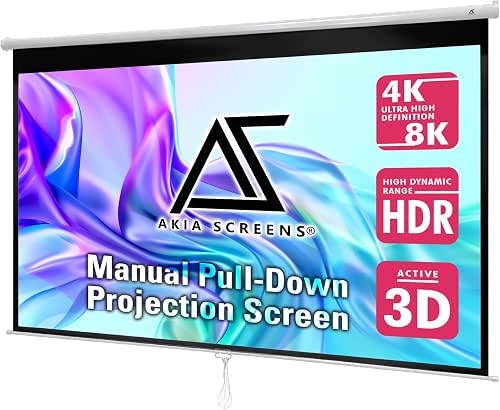
| Best for Color Accuracy | Screen Size: 100-inch diagonal | Aspect Ratio: 4:3 | Operation: Manual pull-down | VIEW LATEST PRICE | Read Our Analysis |
| Elite Screens Manual Projector Screen (M84UWH) |
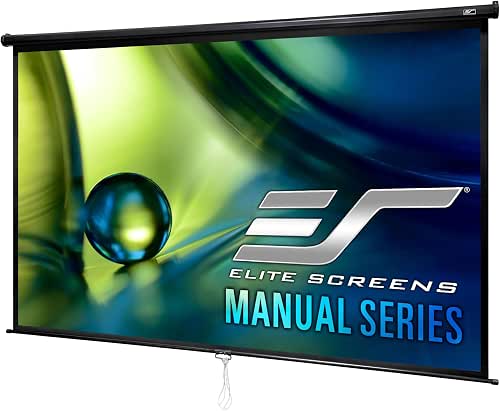
| Best Compact Pick | Screen Size: 84-inch diagonal | Aspect Ratio: 16:9 | Operation: Manual pull-down | VIEW LATEST PRICE | Read Our Analysis |
More Details on Our Top Picks
Elite Screens 100-Inch Manual Pull Down Projector Screen
Should you want a dependable 100-inch screen for a standard UHD or HD projector, the Elite Screens Manual B M100H is a strong fit. You get a 16:9 manual pull-down screen with a 49.2-inch by 87.4-inch viewable area, a 1.1 gain MaxWhite 2 surface, and a 180-degree viewing angle. Its black backing and masking borders improve contrast, while the slow retract, auto-lock, and included lanyard make setup easy. You can mount it onto a wall or ceiling, and the steel case keeps it sturdy.
- Screen Size:100-inch diagonal
- Aspect Ratio:16:9
- Operation:Manual pull-down
- Mounting:Wall/ceiling mount
- Screen Material:MaxWhite 2
- Viewing Angle:180°
- Additional Feature:Slow retract mechanism
- Additional Feature:Auto-lock height settings
- Additional Feature:GREENGUARD Gold certified
Kodak 80″ Manual Pull-Down Projector Screen
The Kodak 80″ Manual Pull-Down Projector Screen is a smart pick should you want an affordable, easy-to-mount screen for home movie nights, classroom lessons, or office presentations. You get a 16:9 matte white surface that works with HD, FHD, and 4K projectors, while the 1.0 gain and 160-degree viewing angle help keep colors natural and glare low. You can mount it on a wall or ceiling, and the pull-down design retracts smoothly once you’re done. Its heavy-duty PVC case looks clean, and the included hardware simplifies setup.
- Screen Size:80-inch diagonal
- Aspect Ratio:16:9
- Operation:Manual pull-down
- Mounting:Wall/ceiling mount
- Screen Material:Matte white
- Viewing Angle:160°
- Additional Feature:Heavy-duty square case
- Additional Feature:Wrinkle-free matte surface
- Additional Feature:Wipe-clean maintenance
Pyle 84-inch Manual Pull-Down Projector Screen
Pyle’s 84-inch manual pull-down projector screen is a smart fit should you want a simple, budget-friendly display for a home theater, classroom, or office. You get a matte white PVC surface with a 160-degree viewing angle, so everyone can see a clear image from off to the side. The black border helps frame content, while the self-locking manual pull-down design lets you set the height you want. You can mount it on a wall or ceiling, and its compact build makes setup easy. Pyle backs it with a 1-year limited warranty.
- Screen Size:84-inch diagonal
- Aspect Ratio:16:9
- Operation:Manual pull-down
- Mounting:Wall/ceiling/surface mount
- Screen Material:Matte white fabric
- Viewing Angle:160°
- Additional Feature:Self-locking mechanism
- Additional Feature:Two top loops
- Additional Feature:Voluntary 30-day returns
SUPER DEAL 120″ Retractable Projector Screen
Provided that you want a large-format screen that’s easy to pull down and stash away, the SUPER DEAL 120″ Retractable Projector Screen fits the bill. You get a 1:1 manual pull-down screen with an 84″ x 84″ view area and a 160-degree viewing angle, so your audience can watch from more seats. Its matte white, black-backed surface helps block light, enhance contrast, and support 4K Ultra HD and Active 3D content. The auto-locking system lets you set height fast, and the retractable housing keeps it protected between uses.
- Screen Size:120-inch diagonal
- Aspect Ratio:1:1
- Operation:Manual retractable pull-down
- Mounting:Inside/outside mount
- Screen Material:Matte white
- Viewing Angle:160°
- Additional Feature:Anti-dust materials
- Additional Feature:Acid-resistant materials
- Additional Feature:Full tension uniformity
Akia 100-Inch Manual Pull Down Projector Screen (AK-M100V1)
Akia Screens’ 100-inch Manual Pull Down Home Theater Projector Screen (AK-M100V1) is a strong pick should you want a budget-friendly, easy-to-install screen for a standard long-throw projector. You get a 4:3 screen with 16:9 and 16:10 compatibility, a 180-degree viewing angle, and a 1.1 gain MaxWhite 2 surface. Its auto-lock system lets you stop it at different heights, and the included lanyard helps you control it. You can mount it on a wall or ceiling, but it won’t work with ultra short throw projectors.
- Screen Size:100-inch diagonal
- Aspect Ratio:4:3
- Operation:Manual pull-down
- Mounting:Wall/ceiling mount
- Screen Material:MaxWhite 2
- Viewing Angle:180°
- Additional Feature:ISF certified color accuracy
- Additional Feature:U.S.-based service team
- Additional Feature:Multiple stop positions
Elite Screens Manual Projector Screen (M84UWH)
In case you want a reliable, budget-friendly pull-down screen for a home theater, classroom, or presentation space, the Elite Screens Manual Series M84UWH is a smart fit. You get an 84-inch 16:9 screen with a 73.2 x 41.3-inch view area, 1.1 gain MaxWhite 2 material, and a 180-degree viewing angle. Its black-backed, four-sided masked surface supports 4K, 8K, HDR, and active 3D. You can mount it on a wall or ceiling, use the auto-lock pull-down design, and trust Elite Screens’ 2-year warranty and lifetime tech support.
- Screen Size:84-inch diagonal
- Aspect Ratio:16:9
- Operation:Manual pull-down
- Mounting:Wall/ceiling mount
- Screen Material:MaxWhite 2
- Viewing Angle:180°
- Additional Feature:ISF certified material
- Additional Feature:Optional L-brackets
- Additional Feature:Front projection design
Factors to Consider When Choosing Manual Projector Screens
Whenever you choose a manual projector screen, start with the right screen size and aspect ratio for your space and content. You’ll also want to check the material and gain, plus the viewing angle, so everyone sees a bright, clear image. Finally, make sure the mounting, installation, locking, and retraction setup fits your room and how often you’ll use it.
Screen Size And Aspect
Choosing the right screen size and aspect ratio starts with matching the screen to your projector’s native output, so you avoid cropped images or distracting black bars. Should you watch widescreen films, 16:9 usually fits best; for older presentations, 4:3 works better; and for slides or graphics, 1:1 can help. Then pick a diagonal size that suits your room. In a home theater, sit about 1.5 to 2.5 times the screen height away. In classrooms or lecture halls, give viewers more distance so text stays readable. Measure the wall carefully, too. Make sure the viewable width and height fit the space, including casing, hardware, and clear sightlines. Were you to switch formats often, consider a multi-aspect screen.
Material And Gain
Once you’ve matched the screen size and aspect ratio to your projector and room, the next big choice is material and gain. You’ll want a matte white surface should you value natural color and steady brightness; gains around 1.0 to 1.1 usually look neutral, with 1.1 giving a small lift in rooms that aren’t fully dark. Should you choose a higher-gain screen, you can get a brighter center image, but you might also see hotspotting and reduced uniformity. A black-backed or fully black-backed fabric helps block stray light and keeps contrast cleaner through stopping bleed-through. For accurate dark-room viewing, look for low-emission certifications and a controlled weave or texture, since both can improve color fidelity and preserve detail in 4K or HDR content.
Viewing Angle Needs
Viewing angle matters most whenever your seating isn’t straight on, because it tells you how far off-center people can sit before brightness and color start to drop. Should your room has side seats or tiered rows, choose a screen with a wide viewing angle, ideally 160° to 180°, so everyone keeps solid contrast and accurate color. Don’t chase brightness alone: higher gain can make the image pop for people in front, but it often tightens the usable angle. For viewers sitting far off center, look for materials that stay color-balanced and specify wide angles, since they reduce washed-out edges. Whenever you compare screens, check whether the listed angle is total or half-angle, because manufacturers don’t always measure it the same way.
Mounting And Installation
Before you buy, make sure the manual screen will actually fit your space and mounting plan. Check that it supports wall and ceiling mounting, then measure the housing’s width, depth, and clearance so it won’t crowd trim, molding, or obstacles. Many 84- to 100-inch screens span about 80 to 95 inches wide, so verify your available space initially. Review the included hardware and the unit’s weight to confirm your wall or ceiling can hold it securely, and use fasteners rated for the load. Choose whether you need an inside or outside mount, and add extension L-brackets should you need to clear something. Finally, position the screen so its center matches eye level and your projector’s throw stays true, reducing keystone distortion.
Locking And Retraction
As you’re choosing a manual projector screen, pay close attention to how it locks and retracts. You’ll want an auto-lock or self-locking system that lets the screen stop at set intervals, often every 2 inches, so you can fine-tune the viewing height. This also helps prevent sudden drops or rebound. Look for a slow-retract or soft-retract design, since it controls roll-up speed, cuts noise, and reduces wear on the fabric and housing. A lanyard or pull handle can make operation safer on high-mounted screens, because you won’t need to overstretch. Check for clear lock indicators and a secure release action. Smooth, dependable movement also protects mounting brackets and roller bearings, helping your screen last longer.
Projector Compatibility
To get the best image from a manual projector screen, match it to your projector’s output and your room setup. Choose a screen aspect ratio that fits your projector’s native format, such as 16:9, 4:3, or 1:1, so you won’t lose image area to cropping or black bars. Check gain and viewing angle next; around 1.0 to 1.1 gain and 160° to 180° viewing usually suit most brightness levels and seating plans. Make sure the screen works with your throw type: standard long-throw projectors pair with most screens, while short-throw and ultra-short-throw models might need special surfaces. Also confirm the material has black backing, and verify the size and mounting fit your space.
Frequently Asked Questions
How Do I Clean a Manual Projector Screen Safely?
Gently remove dust with a microfiber cloth, then wipe the surface with a damp sponge and a small amount of mild soap. Avoid scrubbing or using harsh chemicals. Let the screen air dry completely before rolling it up.
Can Manual Screens Be Ceiling-Mounted in Small Rooms?
Yes, manual screens can be mounted on the ceiling in small rooms if there is enough clearance for the case and the screen’s drop path. Use secure anchors, keep the bracket level, and make sure the screen will not contact furniture or light fixtures.
Do Manual Screens Work Well With Ultra-Short-Throw Projectors?
Yes, you can use a manual screen with an ultra short throw projector, but the setup needs exact alignment. A screen that bows even slightly can warp the image edges, so a flat, tensioned surface works much better.
How Long Does a Manual Projector Screen Typically Last?
A manual projector screen often lasts 5 to 10 years, and careful use can push that even further. Keep the surface clean and raise or lower it gently to help it last longer.
What Causes Wrinkles or Curling on Pull-Down Screens?
Wrinkles or curling often happen when the screen is stored unevenly, left in humid or hot conditions, or pulled down too quickly. You can help prevent this by lowering it slowly and keeping it properly tensioned.
Conclusion
When you choose the right manual projector screen, you’re really choosing the frame for your home theater’s story. A smooth pull-down screen can feel like a blank canvas, turning every movie night into a brighter star. Keep an eye on size, gain, viewing angle, and mounting, and you’ll avoid shadows in the image and in your experience. Pick wisely, and your screen won’t just display visuals—it’ll open a window to sharper, more memorable entertainment.
